Follow the moving air
Record the fan aim, normal doors and nearby ventilation. Include credible changes rather than surveying only the calmest moment. A sheltered bay can still pull air inward when extraction starts or a large door opens.
Practical Fan Specification Notes
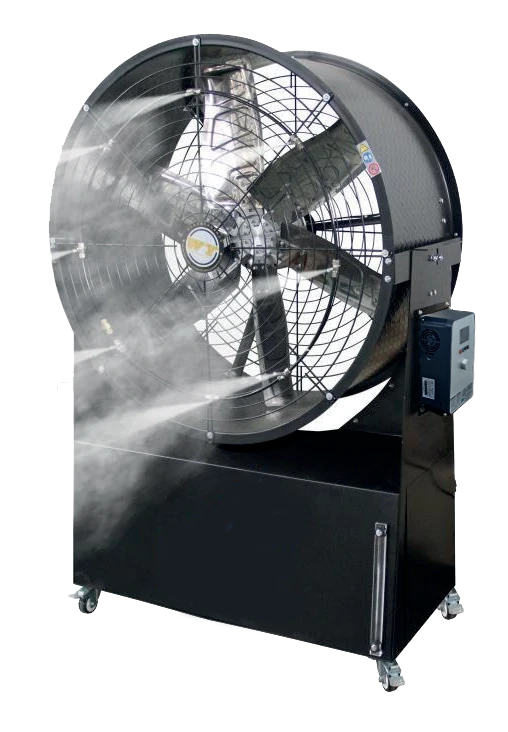
A mist plume does not stop where a sales image ends. Map the dry goods, controls and walking routes before deciding where water can be released.

Direct Answer
Choose mist-fan positions around the surfaces that must stay dry, then assess changing airflow. Wind through a loading door, a passing vehicle or a different fan direction can move droplets beyond the initial observation area. A single dry patch is not an operating envelope.
Set out a no-wetting area for goods, electrical equipment and pedestrian routes with the site owner. The required separation is a project decision supported by observation and the selected equipment instructions; this guide does not invent a universal distance.
If the site cannot keep these areas dry, use another arrangement or operate without water where the exact model permits it. Water-resistant equipment is not permission to spray adjacent stock, cable joints or a floor people need to cross.
Engineering scope and sources reviewed 2026-10-19 · Project conditions still govern final selection
Decision Framework
Record the fan aim, normal doors and nearby ventilation. Include credible changes rather than surveying only the calmest moment. A sheltered bay can still pull air inward when extraction starts or a large door opens.
Packaging adhesives, labels, unfinished material and electrical controls may have different moisture tolerances. Ask their owners what must remain dry. Do not infer a carton’s tolerance from whether its outside looks intact.
The operator needs a clear way to stop water delivery and a person to contact if drift changes. Decide how damp flooring will be dealt with before operation. A floor drain elsewhere does not prove the walking route stays safe or dry.
AirMoveX Catalog Fit
Linked family is a sourcing starting point, not evidence of the interface, performance or installation approval discussed here. Catalog figures are screening references; confirm the exact variant, duty, installation and project documents before specifying.
Field Inputs
Keep this record with the model-specific proposal and unresolved questions.
| Item | Record Or Request | Why It Matters |
|---|---|---|
| Protected areas | Goods, controls, outlets and walkways on a plan | Make the no-wetting boundary visible |
| Air changes | Door states, local extraction and wind direction | Avoid a calm-weather-only decision |
| Water delivery | Offered nozzles, settings and stop method | Tie assessment to the actual configuration |
| Observation | Locations, duration and conditions of any assessment | Keep evidence narrower than the claim |
| Response | Water-off action, floor response and responsible person | Make a changed condition actionable |
Boundary: A layout illustration is not a drift simulation or an approved separation distance. No water-protection rating is claimed for AXS-MS.
Practical Sequence
Connected Decisions
These links continue the same project workflow rather than sending the reader to loosely related content.
Use this product page to identify a starting configuration. The exact offered variant and its current documents must resolve the open items in this guide.
The amount remaining as droplets depends on local conditions, not just fan direction.
Avoid treating a dry-zone layout as a complete mist operating approval.
Questions Buyers Actually Ask
No universal distance is supplied. Use the goods’ moisture requirements, the actual fan instructions and a site-specific drift assessment.
No. Observe relevant operating conditions and changes, and have a practical water-off response.
Not by itself. The equipment’s stated conditions and the complete installation must be reviewed; surrounding goods and walkways still matter.
No. Drafts and operating changes can carry droplets beyond the initial direction. The site assessment must include the protected goods and relevant air movement.
That check describes only its recorded conditions. Door openings, extraction or weather changes may alter drift; define when the setting must be reviewed or water use stopped.
No. Use the goods owner’s actual moisture and packaging requirements. Absence of a visible mark during a short observation does not establish long-term storage suitability.
Source Boundary
These references support the distinctions explained here. External manufacturers’ instructions apply to their named equipment, not automatically to an AirMoveX sourcing reference.
Big Ass Fans
Model-specific example of water handling, fan/mist controls and maintenance. Its sequence and limits do not establish the functions of AXS-MS or AXS-WM.
Open sourceBig Ass Fans
Used only for the evaporation principle and relevance of temperature and humidity. Pad-cooler performance numbers are not transferred to a mist fan.
Open sourceProject Review
AirMoveX is an independent sourcing and project-coordination business, not the manufacturer. Send the site record and open questions above. We can coordinate a model-specific proposal and request supporting documents; missing functions or evidence remain unconfirmed until supplied.
Free preliminary fan layout
Send the building. Get a fan layout and price, usually within 24 hours. Length, width, clear height and voltage are enough to start.
 Supplier catalog image