A buying decision, not a cooling promise

Industrial Mist Fan vs Regular Fan: When Is the Water Worth It?

A mist fan adds more than a water tank to the purchase. Someone has to refill it, keep its water path clean and notice when the mist lands where it should not. Start there before paying for a feature the work area cannot use.

Concept of a stopped six-blade guarded mobile tank fan on a dry open loading bay floor.
Industrial Mist Fan vs Regular Fan: When Is the Water Worth It?AI-generated concept: a stopped, guarded mobile tank fan in an open loading bay for a site-readiness check. No misting output, humidity suitability or independent air/water controls are demonstrated; small generic marks are not AirMoveX branding or certification.
Regular fanAir movement only
Mist fanAir plus added water
First checkCan the work tolerate mist?
Then checkWho owns the water routine?

Direct Answer

Should you buy an industrial mist fan or a regular fan?

Choose a regular circulation fan when air movement is the requirement and added moisture is unwanted. Consider a mist fan only when evaporative cooling can help in the actual conditions, nearby people and materials can tolerate the mist, and the site can manage its water and cleaning. Neither option replaces a required ventilation or contaminant-control system.

The distinction is straightforward: a regular fan moves air; a mist fan also introduces water intended to evaporate. The result depends on the air conditions and the way the mist is delivered. A dry afternoon trial does not establish the result on a humid production shift.

The useful question is not simply “Which feels colder?” It is “Can this position use mist throughout the shift without creating another problem?” If the answer is uncertain, ask for a controlled, model-specific trial rather than a larger cooling claim.

Engineering scope and sources reviewed 2026-10-19 · Project conditions still govern final selection

Decision Framework

Four checks before adding mist to the brief

These checks can rule out an unsuitable purchase before you spend time comparing tank sizes.

01

Humidity changes the opportunity

Evaporation has more opportunity in drier air. As the air becomes more humid, less evaporative cooling is available under otherwise similar conditions. Do not use one relative-humidity cutoff as a universal rule: temperature, air movement, mist delivery and the acceptable outcome also matter. Record the conditions of any demonstration.

Check mist-fan humidity at the site — Record temperature, humidity and air movement during the proposed operating period before a supervised trial.
02

The work may matter more than the weather

Look beyond the person standing in front of the fan. Check packaging, unfinished goods, moisture-sensitive powders, coatings, electrical equipment and nearby walkways. A comfortable operator is not evidence that a carton, process or machine can accept the same exposure. Obtain the process owner’s decision before the trial.

Assess mist drift near dry goods — Identify moisture-sensitive goods, controls and walkways before choosing a trial position.

03

A water tank creates a recurring job

Confirm the water quality required by the actual manual, the available supply, access for cleaning and an acceptable drain or collection route. Assign a person and an end-of-use routine. A large tank is not a hygiene plan, and topping it up does not remove existing contamination or deposits.

04

Fan-only operation must be confirmed

Independent fan and mist controls can make a unit more useful as conditions change, but they are not a universal feature. The Torrent product page explicitly describes separate control of fan speed and mist; that is evidence for that model, not for an AirMoveX-sourced alternative. Ask for the offered unit’s controls and instructions in writing.

Confirm separate fan and mist controls — Request the offered model's control sequence and instructions; a photograph of a knob is not proof of fan-only operation.

AirMoveX Catalog Fit

Start With The Real Product Families

AXS-MS maps to the mobile six-blade WYFJ-P1100 tank-cabinet reference; AXS-WM maps to the three-blade WYFJ-P950 wall-mount reference. Mist suitability and the separate water-system scope need project review. Catalog figures are screening references; confirm the exact variant, duty, installation and project documents before specifying.

Field Inputs

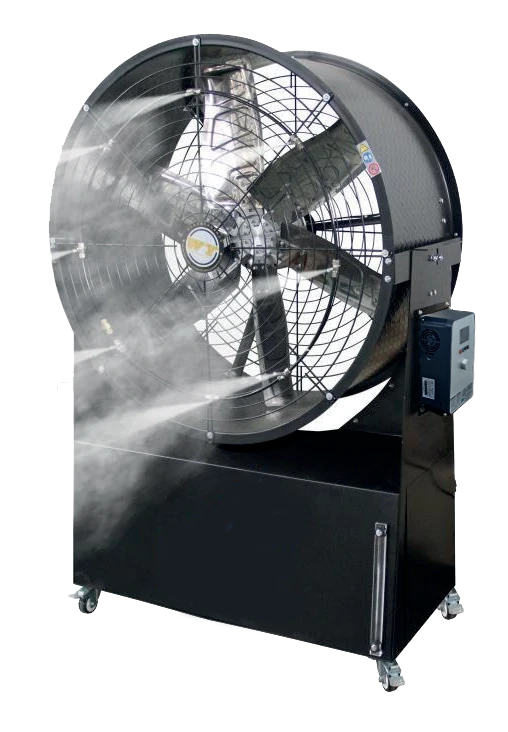
Mist fan or regular circulation fan: the practical comparison

Use the right-hand column as a purchase checklist. A blank answer means the selection still needs work.

DecisionRegular circulation fanMist fan: extra information needed
Main taskMove air across the intended occupied zoneConfirm why adding evaporating water is useful at this location
Moisture-sensitive workNo intentional water mist, but check ordinary fan suitabilityObtain acceptance for the process, goods, nearby equipment and walkways
Changing conditionsAdjust air movement within the unit’s allowed operationConfirm fan-only mode and who decides when to stop misting
UtilitiesCorrect electrical supply and a suitable locationAlso establish approved water source, refill access and drainage
MaintenanceFollow the fan and guard cleaning instructionsAlso obtain the model’s reservoir, filter, line and atomizer/nozzle routine
Operating costUse actual input power, hours and tariffInclude actual water use, consumables and staff time; no assumed savings
Trial evidenceAir movement and usability at the intended positionsAlso record air conditions, mist drift, surface wetting and end-of-shift workload

Boundary: A mist fan is not the same construction as a wet-pad evaporative cooler. No universal temperature reduction, coverage area, water consumption, runtime or safe exposure distance is established by this comparison.

Practical Sequence

A six-step buying trial that answers the real question

  1. Describe the position and the jobMark where people actually work, what materials are exposed and where the air would travel. State whether the objective is local comfort or a ventilation duty. Include the site’s existing ventilation and restrictions rather than expecting a portable comfort device to correct an unrelated air-quality problem.
  2. Record representative conditionsNote temperature and relative humidity at the location, with the time and operating conditions. Include the difficult part of the shift where practicable. Do not compare a mist unit beside an open door with a regular fan in a different room and call the result an equipment comparison.
  3. Clear the water and electrical arrangementsUse the offered model’s manual to establish a suitable location, stable placement, electrical arrangement, water requirements and access. Keep routes clear and manage hoses. The installer or responsible site team must confirm these arrangements; this guide is not a wiring or water-system installation instruction.
  4. Compare fan-only operation, then approved mist operationAt the agreed position, assess whether ordinary air movement already meets the need. Add mist only after the site permits it. Record settings, conditions and observations. Watch the work zone and surrounding surfaces, not just the person nearest the outlet. Stop misting if drift or wetting violates the agreed boundaries.
  5. Check the cause of any wettingDo not explain every wet floor as “too humid.” Observe whether water is drifting, leaking from a connection or escaping from a return/drain arrangement. Follow the actual manual and supplier process to resolve the issue. A towel under a recurring leak is not a passed trial.
  6. Close the trial with the cleaning taskHave the intended operator demonstrate the end-of-use, drain, cleaning and storage routine under the model’s instructions. Record the time, access and disposal needs. Approve a purchase only when the performance observation and the recurring work are both acceptable; otherwise select fan-only operation or revisit the brief.

Connected Decisions

Use The Next Page Only When It Answers The Next Question

Follow the next decision with these related guides.

04

Assess outdoor exposure

Adding mist does not make a complete assembly weatherproof or suitable for every location.

Questions Buyers Actually Ask

Questions worth asking before ordering a mist fan

Is a mist fan always better than a regular fan?

No. Added water may be useful where evaporation can help and the work area accepts mist. A regular circulation fan is the clearer choice when moisture is unwanted or the site cannot manage the water and cleaning routine.

Will a mist fan work in humid air?

The evaporative opportunity decreases as humidity rises under otherwise similar conditions. There is no single cutoff or guaranteed result supplied here. Trial the proposed unit in representative temperature, humidity and operating conditions, watching nearby surfaces as well as comfort.

Can a mist fan run without water?

Some models provide a fan-only mode, but confirm that function and the correct control sequence for the offered unit. Do not assume an empty tank is an approved way to run a pump or atomizer.

Does a bigger water tank mean longer useful runtime?

Not by itself. Actual runtime depends on usable capacity, water consumption at the chosen settings and the refill arrangement. Cleaning, water quality and the operator’s end-of-use routine still matter. Obtain model-specific figures and their conditions.

Why is the floor getting wet?

Possible causes include mist reaching a surface before evaporating, drift, leaking connections or a problem in a return or drainage path. Stop the unacceptable condition and investigate under the unit’s instructions; do not diagnose humidity from a wet floor alone.

What should we send AirMoveX for a comparison?

Send the location and work-zone layout, representative temperature and humidity, moisture-sensitive materials, electrical and water availability, drainage arrangements and the intended cleaning owner. Ask for the exact proposed model, controls, manual and included water-system parts.

Source Boundary

References Used For This Guide

Sources support the specific principles noted below. They do not supply specifications or approvals for a different manufacturer’s equipment.

Big Ass Fans: evaporative coolers and misting products

Supports distinguishing wet-pad evaporative cooling from direct misting and the relevance of drier conditions. Product-specific performance is not transferred to another unit.

Open source

Big Ass Fans: Torrent portable misting fan

The separate fan-speed and mist controls are a model-specific example, not a confirmed AirMoveX feature.

Open source

Torrent operation and maintenance manual, Rev A, March 17, 2025

English operation, maintenance and storage sections document water handling, reservoir cleaning/drying, filters, lines and return-path checks. Rotating-atomizer instructions are not generalized to nozzle-based machines.

Open source

Project Review

Ask whether the added water solves your actual problem

Send the work-zone brief and the conditions you need to handle. AirMoveX can coordinate a regular-fan or mist-fan proposal and request the actual model’s water requirements, control modes and cleaning instructions. Missing evidence stays an open question, not a cooling promise.

Free preliminary fan layout

Send The Building. We Size The Fans.

Send the building. Get a fan layout and price, usually within 24 hours. Length, width, clear height and voltage are enough to start.

Request A Fan Layout