Find the measurement boundary
Ask whether a watt figure is motor shaft output, motor electrical input or supply input to the complete fan and controller. A package may also include lights or a water system. Compare the same boundary on both offers.
Industrial Fan Buying Notes
Two suppliers can quote the same current and still describe different electrical loads. Before choosing a socket or estimating a bill, find out which quantity each number actually represents.

Direct Answer
Amps describe current, watts describe real power and volt-amperes describe apparent power. Multiplying supply volts by amps does not generally give a fan’s actual input watts. Identify phase, measurement boundary and power factor before using the numbers together.
For a single-phase sinusoidal supply, real input power is P = V × I × PF. For a balanced three-phase system, P = √3 × line-to-line V × line I × PF. For example only, 230 V × 2 A is 460 VA; with PF = 0.8 it would be 368 W. None of these example inputs describes the pictured product.
A controller can complicate measurement. Distorted waveforms, changing speed and different input/output boundaries make a simple clamp-current estimate unreliable. Use suitable true-power measurement for the supply and drive involved. Motor shaft-output power is also not the same as complete fan-package electrical input.
Engineering scope and sources reviewed 2026-10-18 · Project conditions still govern final selection
Decision Framework
Resolve these points against the offered model and the actual workplace, not a similar-looking photograph.
Ask whether a watt figure is motor shaft output, motor electrical input or supply input to the complete fan and controller. A package may also include lights or a water system. Compare the same boundary on both offers.
Nameplate rated current serves a different purpose from an observed current at one speed. Do not use a single running observation as the whole basis for circuit, protection or starting requirements. Have the responsible electrical designer check those requirements.
Lower amps can reflect a different voltage, phase, speed, load or power factor. It is not evidence that one fan supplies the same useful airflow more efficiently. That needs matched-duty input-power and air-performance evidence.
Field Inputs
Put these answers in the purchase brief so a quotation can be checked rather than guessed.
| Check | Ask Or Record | Decision It Supports |
|---|---|---|
| A | Supply phase, voltage and rated versus measured current | Describe current without assuming watts |
| W or kW | Input/output boundary and operating condition | Compare real power on the same basis |
| VA or kVA | Voltage, current and phase arrangement | Describe apparent power, not billed energy |
| PF | Relevant operating point and measurement method | Relate real and apparent power correctly |
Boundary: The equations describe stated electrical conditions, not a wiring design. No power factor, circuit size or measured running power is claimed for the catalog fan.
Practical Sequence
Visual Check
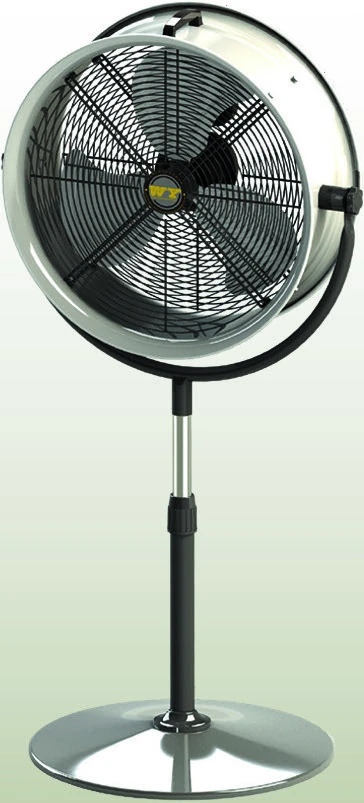
The supplier-catalog image below is the product configuration reference. The generated scene above explains the article topic; it is not a photograph of an installation, a supplied package or a performance test.
Connected Decisions
These links continue the same project workflow rather than sending the reader to loosely related content.
Use real power and an actual operating schedule.
The electrical package affects the measurement boundary.
Request the exact electrical data rather than inferring it from the image.
For several industrial fans, collect running and starting-current evidence for the complete offered package before agreeing simultaneous or staged starting.
Questions Buyers Actually Ask
It is 460 VA for a single-phase calculation. Real watts require the applicable power factor and a suitable measurement basis; they are not automatically 460 W.
Not directly. One describes mechanical output and the other electrical input. Include motor, controller and any accessory boundaries before comparing.
Not by itself. Compare real electrical input at the same useful airflow duty and identify voltage, phase, speed and test conditions.
Not reliably by themselves. Obtain relevant real input power and an operating schedule. Energy in kWh is the time total of real kW, not the product of a headline current and assumed hours without the missing electrical basis.
No. Frequency is a control or operating quantity, not a wattmeter reading. Use a suitable real-power measurement or documented input data for the complete package.
Not unchanged. For a balanced three-phase supply, real power is √3 × line-to-line voltage × line current × power factor. Confirm the phase and measurement boundary; unbalanced loads or drive waveforms call for an appropriate measurement method rather than an assumed calculation.
Source Boundary
The supplier catalog identifies the pictured configuration, not a tested installation. Where external references are listed, they support only the stated method and do not validate an AirMoveX performance claim.
Supplier catalog supplied to AirMoveX
Source of the product image and illustrated configuration only. The private catalog is not a customer installation record, independent performance test or certification. Request the exact offered model and current documents.
Project Review
Send the site conditions and the checklist above with your Industrial pedestal fan inquiry. AirMoveX can coordinate the proposed configuration and supporting documents. Unconfirmed values remain open items in the quotation, not assumed product features.
Free preliminary fan layout
Send the building. Get a fan layout and price, usually within 24 hours. Length, width, clear height and voltage are enough to start.